
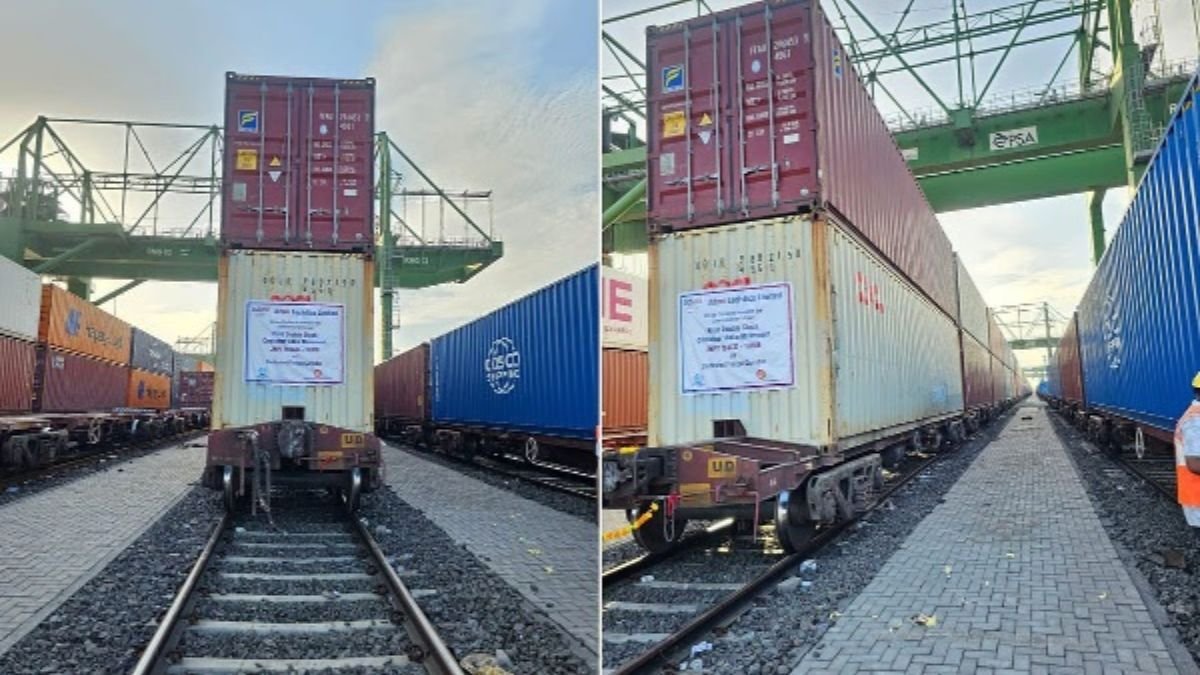
- Report by Swati
New Delhi | August 22, 2026
Indian Railways has achieved a major operational milestone by successfully dispatching its first 1.3-km-long double-stack container train on the Western Dedicated Freight Corridor (WDFC) from Jawaharlal Nehru Port (JNPT), Mumbai, towards Varnama in Gujarat’s Vadodara Division.
Railway Minister Ashwini Vaishnaw announced the development in a post on X, describing it as the first long-haul double-stack container train on the Western Dedicated Freight Corridor operating on the JNPT–Vadodara route.
The train carried 360 Twenty-foot Equivalent Units (TEUs) of containers and covered approximately 422 kilometres. The loaded formation departed from JNPT at 7 pm on Friday.
Two Double-Stack Rakes
The long-haul formation consisted of two double-stack rakes.
The leading rake was hauled by locomotive 60311, with a load of 45+1 and a tonnage of 1,817 tonnes. The trailing rake was hauled by locomotive 24690, also with a load of 45+1, and had a tonnage of 2,105 tonnes.
Together, the two rakes transported 360 TEUs in a single movement, demonstrating Indian Railways’ capability to handle large volumes of containerised freight efficiently.
Faster Cargo Movement, Lower Congestion
The operation is expected to help reduce container dwell time at ports and terminals, minimise congestion and facilitate faster evacuation of cargo.
Double-stack trains can carry more containers in a single movement, reducing the number of locomotives, flat wagons and train movements required to transport an equivalent volume of freight.
This also enables better utilisation of available freight corridor capacity and can contribute to shorter overall transit times.
Major Push for Green Freight
The electrically hauled train also supports Indian Railways’ focus on green and sustainable freight transportation.
A single double-stack long-haul train can carry cargo equivalent to that which would otherwise require a large number of trucks. This can help reduce diesel consumption, road congestion, vehicular emissions and the overall carbon footprint of freight movement.
The milestone strengthens India’s rail-based logistics network and highlights the growing role of dedicated freight corridors in moving high volumes of cargo efficiently and sustainably.