
https://theheadlinepost.com/
BJPBusinessCountryCrimeDehradunEducationEntertainmentInternationalNew DelhiReligionSportsTourismTrafficUttar PradeshUttarakhand

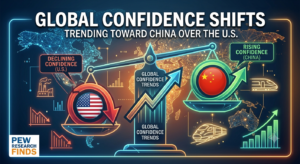
Global Confidence Shifts Toward China Over the U.S., Pew Research Finds

Report by SWATI

New Delhi/Washington:
A new Pew Research Center survey has revealed a significant shift in global public opinion, with confidence in China increasing relative to the United States in several parts of the world. The findings suggest that many countries now view Beijing as a more influential and reliable global actor than Washington.
According to the report, favorable perceptions of China have improved in a number of surveyed nations, while confidence in the United States has either stagnated or declined. The survey points to changing geopolitical dynamics, economic partnerships, and differing views on international leadership as key factors behind the trend.
India Still Leans Toward the United States
Despite the broader shift, India remains an exception. The majority of Indian respondents continue to express greater confidence in the United States than in China. Analysts say India’s strategic partnership with Washington, growing defense cooperation, and expanding economic ties continue to influence public opinion.
Trump Receives Low Confidence in Pakistan
The survey also highlights particularly low confidence in former U.S. President Donald Trump among respondents in Pakistan. Only around 12 percent of Pakistanis surveyed said they had confidence in Trump’s leadership on global affairs.
Is China Becoming the World’s Preferred Leader?
While the United States remains the world’s largest military power and one of its leading economies, the Pew findings indicate that China’s global standing has strengthened considerably. In several regions, respondents now express higher levels of trust in China’s role in international affairs than in that of the United States.
Experts caution that the results do not necessarily mean China has replaced America as the world’s dominant power. Instead, they reflect a growing perception that Beijing is becoming an increasingly influential competitor in shaping global politics, trade, infrastructure development, and diplomatic engagement.
A Changing Global Landscape
The survey underscores a broader transformation in international public opinion, with countries reassessing traditional alliances and evaluating emerging powers through the lens of economic opportunities, security concerns, and diplomatic outreach.
As competition between Washington and Beijing intensifies, the Pew Research findings suggest that the battle for global influence is no longer confined to governments alone—it is increasingly being fought in the court of public opinion.
Source: Pew Research Center global survey on international confidence and leadership perceptions.

Related posts

Supreme Court Issues Ultimatum to Centre Over Front-of-Pack Food Warning Labels Category: National | Health | Supreme Court | Food Safety By Swati | The International Desk | The Headline Post New Delhi: The Supreme Court has issued a stern ultimatum to the Centre over the implementation of front-of-pack warning labels on packaged food products containing excessive levels of sugar, salt and saturated fat, questioning the government’s approach to a measure aimed at protecting public health. A Bench comprising Justice J.B. Pardiwala and Justice K. Vinod Chandran expressed strong displeasure over the stance adopted by the Centre and the Food Safety and Standards Authority of India (FSSAI). The court questioned whether regulatory authorities were being influenced by corporate interests while framing food-labelling policies. The matter arose during a Public Interest Litigation concerning mandatory warning labels on packaged food. The petitioner argued that consumers, particularly children, need clear and prominent information about the nutritional risks associated with products high in added sugar, salt and saturated fats. The Bench also scrutinised the FSSAI’s position, observing that its submissions appeared to emphasise opposition from the food industry while allegedly failing to adequately acknowledge evidence supporting warning labels as a tool to discourage excessive consumption of unhealthy ingredients. The court referred to minutes of an FSSAI meeting held on March 7 and noted an apparent contradiction between the regulator’s position and its earlier directives. During the hearing, the Bench questioned Additional Solicitor General Brijender Chahar, representing the Centre, over whether the government was reluctant to take necessary action despite the court’s earlier directions. The controversy highlights the larger policy battle between public-health advocates seeking stronger nutritional safeguards and sections of the food industry opposing stringent front-of-pack warning requirements. The Supreme Court’s intervention has placed renewed focus on the need for transparent food labelling, particularly as lifestyle-related health risks associated with excessive consumption of sugar, salt and saturated fats continue to attract public-health concern. Key Takeaway: The Supreme Court has made it clear that food-labelling policy cannot be shaped merely by commercial considerations and has pressed the Centre and FSSAI for effective action on front-of-pack warning labels.

The Headline Post

80th Independence Day Celebrations: Nation Marks Azadi Ka Amrit Mahotsav with Grandeur

The Headline Post

Uttarakhand Purification Row Escalates: CM Dhami Hits Back at Congress, Says Allegations Lack Evidence

The Headline Post

Leave a Comment