SWATI
New Delhi | September 11, 2026
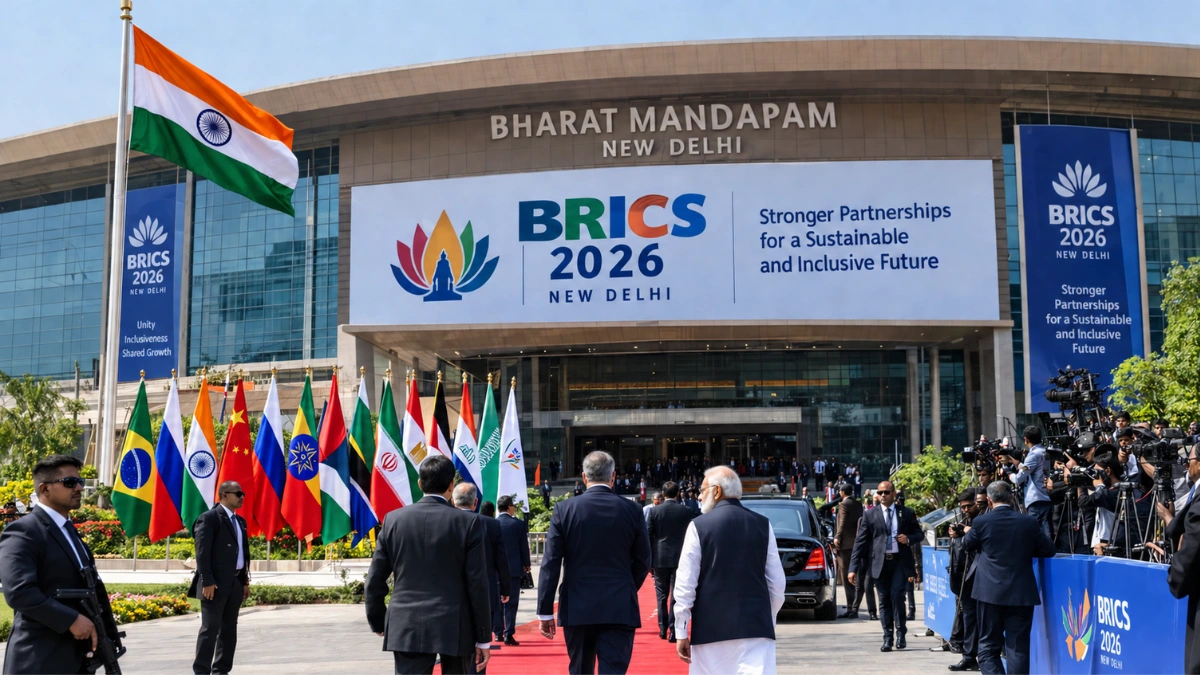
The world’s diplomatic spotlight is firmly fixed on New Delhi as India prepares to host the 18th BRICS Summit on September 12–13, bringing together some of the most influential leaders of the Global South.
At the heart of the summit will be three powerful faces of the emerging geopolitical landscape — Prime Minister Narendra Modi, Russian President Vladimir Putin and Chinese President Xi Jinping.
The summit is being held at a time of deep global uncertainty, with wars, trade tensions, shifting alliances and growing competition among major powers reshaping international politics. Against this backdrop, BRICS is increasingly being viewed as a major platform through which emerging economies seek a greater voice in global governance.
Modi-Putin-Xi: The Power Triangle
Putin has already arrived in New Delhi for the summit and is expected to hold bilateral discussions with Prime Minister Modi. His visit underlines the continuing strategic importance of the India-Russia relationship.
Xi Jinping’s presence carries an even stronger diplomatic message. It is his first visit to India in seven years and comes after years of tension following the 2020 border clash.
The expected interaction between Modi and Xi will therefore be watched closely for signals on border stability, trade, investment and the broader India-China relationship.
For New Delhi, the challenge is to maintain strategic autonomy while simultaneously managing relations with Moscow, Beijing, Washington and the wider Global South.
BRICS Becomes Bigger — and More Complicated
The expansion of BRICS has transformed it from a grouping of major emerging economies into a much broader geopolitical platform.
The enlarged grouping now has 11 member countries, while partner countries have also been brought into its wider framework. Together, the bloc represents a substantial share of the world’s population, economic output and global trade.
But greater size also means greater complexity.
BRICS members do not always share the same strategic interests. The Iran conflict, differences between member states and competing relationships with Western powers are testing the bloc’s ability to produce a unified geopolitical position.
From Diplomacy to Business
BRICS 2026 is not only about presidential handshakes and geopolitical symbolism.
Trade, energy security, supply chains, digital payments, artificial intelligence and investment are expected to occupy a central place in the discussions.
Proposals under consideration include a BRICS Startup Innovation Fund, an Incubator Network and a Logistics and Supply-Chain Cooperation Framework aimed at strengthening entrepreneurship, innovation and economic connectivity among member states.
For India, these initiatives could translate into opportunities for startups, manufacturing, technology, logistics and cross-border trade.
Can BRICS Create a New World Order?
One of the biggest questions surrounding the summit is whether BRICS can evolve from an economic grouping into a decisive force in a multipolar world.
American economist Jeffrey Sachs has argued that closer cooperation between India and China could play a significant role in shaping a new global order.
Yet BRICS is not a military alliance and its members have significant differences.
Its real strength may therefore lie not in becoming an alternative to the West, but in creating a larger negotiating space for countries of the Global South.
The Real Action May Happen Behind Closed Doors
The most consequential diplomacy may not take place during the televised sessions.
Bilateral meetings, corridor conversations, brief informal encounters and last-minute negotiations between leaders and senior officials often determine the language of summit declarations and the direction of future cooperation.
That makes every Modi-Putin-Xi interaction significant.
A handshake, a private meeting, a joint photograph or even a brief conversation could send a powerful diplomatic signal to Washington, Moscow, Beijing and the rest of the world.
India’s Moment on the Global Stage
For India, BRICS 2026 is an opportunity to demonstrate that New Delhi can act as both a major economic power and an independent diplomatic centre.
India’s message is likely to revolve around strategic autonomy, development, reform of global institutions, technology cooperation and a stronger voice for the Global South.
The summit therefore represents more than another international gathering.
It is a test of whether BRICS can convert its growing economic weight into meaningful geopolitical influence — and whether India can use its chairmanship to shape that transformation.
As Modi, Putin and Xi share the same diplomatic stage in New Delhi, the world will be watching not just what they say, but what their meetings signal about the future balance of power.